
Most businesses know something is wrong with their website before they act on it. The design feels dated. Traffic is not converting. Competitors have moved ahead. The instinct is usually right; the question is how to diagnose exactly what is wrong, and whether a targeted refresh or a full strategic redesign is the right response.
A website needs redesigning when it no longer serves its primary commercial purpose of generating trust, converting visitors, and accurately representing your business. This is triggered by performance data, design obsolescence, or business change. Most businesses benefit from a major redesign every three to five years, but performance indicators are a more reliable trigger than time alone.
A website is a commercial asset that depreciates faster than most businesses account for. The web design landscape shifts every two to three years. Google's ranking standards evolve continuously. User tolerance for slow or confusing experiences has shortened significantly.
80.8% of businesses commission a redesign because their site is failing to convert, not because it looks old. Use the fifteen signs below as a diagnostic. Not every sign requires a full rebuild, but every sign that applies is costing you leads, credibility, or time.
These are the most commercially urgent. Performance failures have a direct, measurable impact on revenue.
Sign 1: High bounce rate.
Visitors leave within seconds without scrolling or clicking. Users form a first impression in 0.05 seconds. If your above-the-fold section fails to communicate relevance instantly, they go.
Sign 2: No leads from the site.
You receive traffic but no enquiries, bookings, or purchases. This is a structural conversion problem: misplaced CTAs, unclear value proposition, or missing trust signals. Good UX design can increase conversion rates by up to 400%.
Sign 3: Slow page load speed.
Pages take more than three seconds to load on mobile. 53% of mobile users abandon sites that take longer than three seconds, and a one-second delay reduces conversions by 7%. Speed is both a lead generation and an SEO issue.
Sign 4: Declining organic traffic.
Month-over-month organic traffic falls despite no visible ranking penalty. This usually points to outdated technical architecture, content not structured for modern search intent, or missing E-E-A-T signals in 2026's AI-influenced search environment.
Sign 5: Failing Core Web Vitals
Google Search Console shows poor LCP, CLS, or INP scores. These directly affect search rankings and indicate structural performance problems in how the site was built, not fixable with surface-level changes.
These affect credibility and first impressions, the foundation of trust in any commercial relationship.
Sign 6 Design looks dated next to competitors.
Your site feels like it belongs to a different era compared to competing businesses. 75% of users judge credibility based on website design. A dated site signals a business that has not evolved, regardless of actual service quality.
Sign 7: Website does not reflect the current brand
Your logo, colours, or positioning have changed, but the website still shows the old version. When your social media, proposals, and presentations communicate one brand and your website communicates another, it creates doubt at the first point of contact.
Sign 8 Not mobile-optimised
Text is small, buttons are hard to tap, or the layout breaks on mobile devices. Over 60% of global web traffic comes from mobile, and Google uses mobile-first indexing, meaning your mobile version is what determines your search rankings.
Sign 9 Unclear visual hierarchy.
Visitors cannot tell at a glance what is most important or what to do next. When everything is weighted equally, nothing stands out, and visitors who cannot orient themselves quickly leave without acting.
Sign 10: Generic or outdated imagery.
Stock photography, old team photos, or product images that no longer reflect your current offering. Imagery communicates quality; tier generic visuals signal low investment in brand identity and create questions about whether the business is current and active.
These reflect a mismatch between what your site can do and what your business now needs from it.
Sign 11: Cannot update the site without a developer
Changing a service description, adding a blog post, or updating a team page requires a support ticket and days of waiting. Your CMS should empower your team, not create a bottleneck for every routine content change.
Sign 12: Services on the site are inaccurate.
Old services are still listed. New capabilities are missing. Case studies no longer reflect your current quality level. Misaligned service information creates misaligned expectations at the very start of the sales conversation.
Sign 13: No analytics or no one reads them.
You do not know how many visitors your site gets, which pages they view, or where they drop off. A website without behavioural data is a marketing investment with no feedback loop. You cannot improve what you cannot measure.
Sign 14: Website is not accessible.
Screen readers cannot navigate the site, colour contrast is insufficient, or forms lack proper labels. WCAG 2.2 accessibility is increasingly a legal requirement in India, the UAE, and the USA, and accessibility improvements benefit both users and search engine comprehension.
Sign 15: Site does not support your growth goals.
You are entering a new market, repositioning upmarket, or targeting a new audience, and your current site was built for a different version of your business. When website strategy and business strategy diverge, the website becomes a ceiling on growth.
Not every sign on this list requires a full rebuild. Here is how to decide:
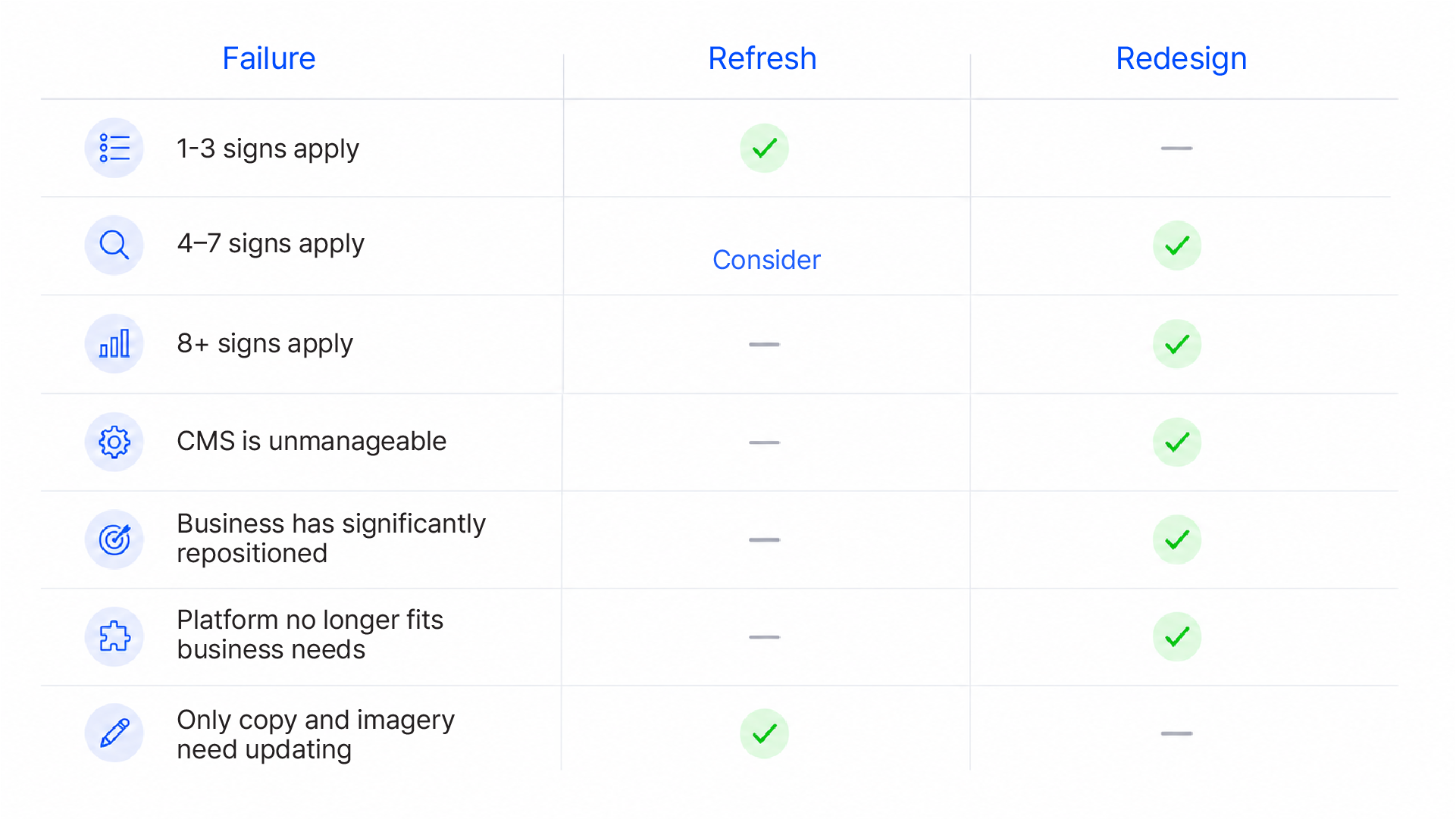
Condition Refresh Redesign 1–3 signs apply 4–7 signs apply Consider 8+ signs apply CMS is unmanageable Business has significantly repositioned Platform no longer fits business needs Only copy and imagery need updating
A refresh makes targeted improvements: updated photography, revised copy, and faster load time without rebuilding the underlying architecture. A full redesign starts from the ground up: new platform, new information architecture, new design system, new content strategy. Choose based on whether the limitations are structural or cosmetic.
A website is not a one-time delivery. It is a living business asset, and when the gap between what it reflects and what your business has become grows wide enough, it starts costing you leads, credibility, and growth.
The question is not whether your website looks good. The question is whether it does its job.
At Integra Magna, we evaluate websites as commercial systems, not design artefacts. If you want an honest assessment of where your site is underperforming and a clear recommendation on what to do next, let us talk.
How do I know if my website needs a redesign?
The clearest indicators are commercial: your site is not generating leads, your bounce rate is high, your organic traffic is declining, or it no longer reflects your current services or positioning. If four or more of the fifteen signs in this article apply, a redesign conversation is warranted.
How often should a business redesign its website?
Most businesses benefit from a major redesign every three to five years. However, performance and conversion data are more reliable triggers than the calendar redesign when the site is no longer serving its commercial purpose, not just because time has passed.
What is the difference between a website refresh and a full redesign?
A refresh makes surface-level improvements to an existing structure: updated copy, new imagery, CTA repositioning, speed fixes. A redesign rebuilds from the ground up: new platform, architecture, design system, and content strategy. Choose a refresh when the core is sound; choose a redesign when structural limitations are causing the performance problems.
How much does a website redesign cost?
For a professionally built site in 2026, typical ranges are: ₹2.5L–₹8L for a small business site; ₹8L–₹25L for a mid-market business with custom design and CMS; enterprise projects vary beyond that. The more important question is the cost of not redesigning a site; failing to convert one qualified lead per month can represent significant revenue loss annually.
Will a website redesign hurt my SEO?
A poorly managed redesign can temporarily affect rankings: broken redirects, changed URLs, lost page authority. A well-managed redesign improves SEO through better Core Web Vitals, cleaner architecture, and stronger E-E-A-T signals. Always ensure SEO continuity is built into the redesign process from the start.