
Will AI take your job? The direct answer is no, AI will not replace creative professionals who adapt, but professionals using AI will replace those who do not. To future-proof your career against Generative AI, you must cultivate the five irreplaceable human skills: emotional intelligence, systems thinking, advanced curation, cross-disciplinary strategy, and ethical foresight. While tools can generate pixels and code, they cannot replicate human empathy or strategic intent.
The rapid integration of AI design tools like Midjourney, ChatGPT, and AI-driven Figma plugins has fundamentally shifted the creative landscape in 2026. The technical barrier to entry for producing high-fidelity assets has dropped to zero. If your entire value proposition relies on technical execution, creating a clean layout, generating an illustration, or drafting standard website copy, your role is highly vulnerable to AI job replacement.
However, this technological leap is an opportunity, not an apocalypse. By shifting your focus from "how to create it" to "why to create it," you can elevate your value. Here are the five vital future-proof AI skills you need to master.
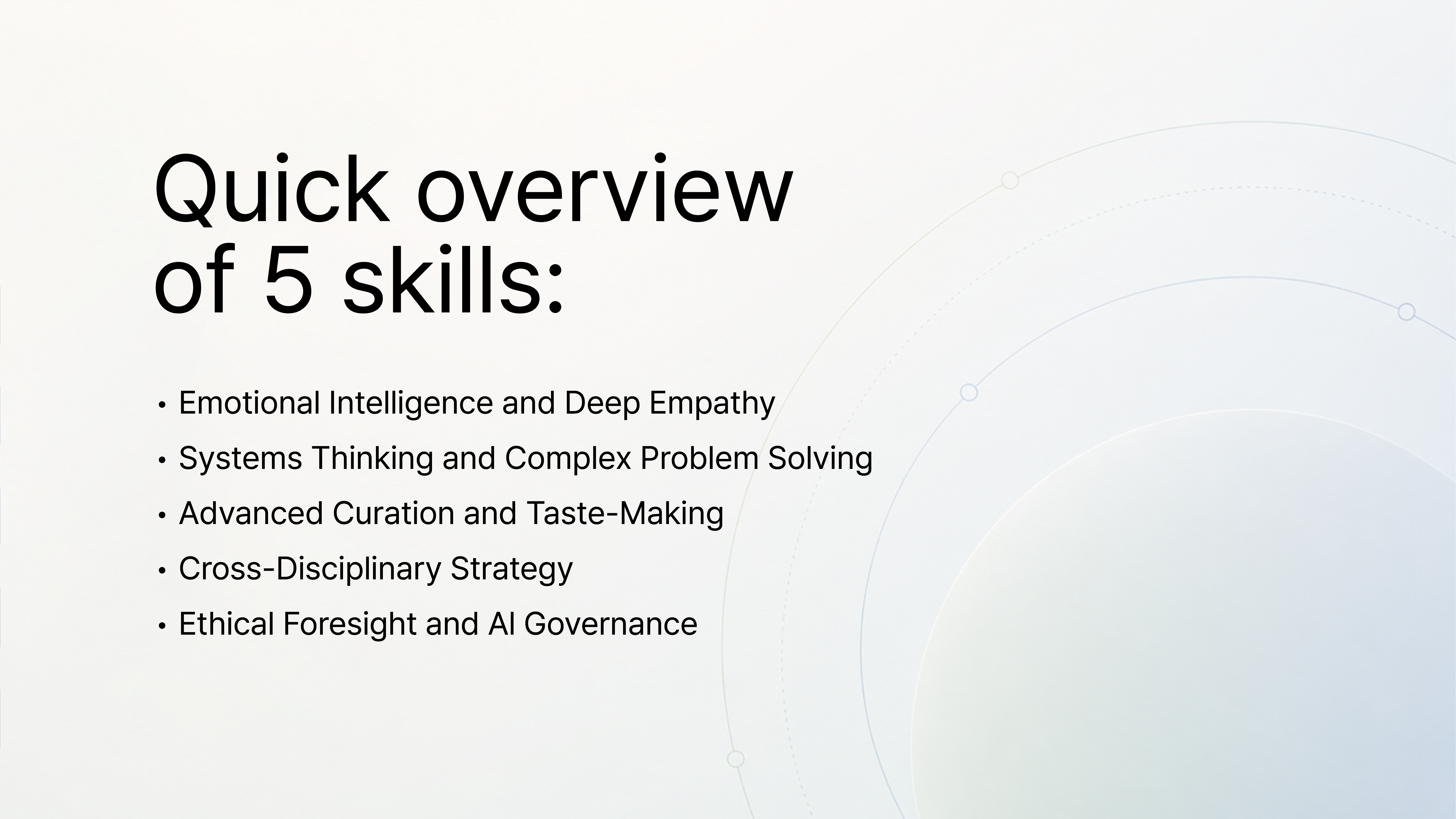
1. Emotional Intelligence and Deep Empathy (The Human Core):
Artificial intelligence has no lived experience. It cannot feel frustration, joy, or the nuance of an unmet customer need. Emotional intelligence (EQ) is the single most critical differentiator between human and machine output.
Why It Matters:
AI operates on historical data and probabilistic models. It can simulate empathy based on typical responses, but it cannot actively listen to a client, interpret their unspoken anxieties, and read the room during a pitch.
How to Build This Skill:
"AI can give you the statistically most probable answer, but it takes a human to find the most emotionally resonant one."
2. Systems Thinking and Complex Problem Solving
Generative AI excels at solving isolated problems. If you need a logo or a function written in Python, the machine delivers. But what happens when that logo needs to fit within a global, culturally aware brand architecture, or that function needs to interface with a deeply flawed legacy database?
Understanding Systems Design
Systems thinking is the ability to understand how different components interact within a larger ecosystem. It is moving from being a task-executor to a strategic architect. AI struggles with ambiguity and interconnected, chaotic real-world systems.
Key Applications in 2026:
By becoming a systems thinker, you elevate yourself from a "doer" to a "director" who orchestrates the AI tools to achieve a complex, unified goal.
3. Advanced Curation and Taste-Making:
When the cost of generating content goes to zero, the market is flooded with mediocrity. In a world where an infinite number of variations can be created in seconds, the dominant skill becomes curation.
The Era of the Taste-Maker
Taste involves aesthetic judgment, cultural awareness, and a highly refined sense of context. You must become the ultimate filter.
Tactics for Refining Curation:
In the age of AI abundance, the editor is more valuable than the creator.
4. Cross-Disciplinary Strategy:
Specialization was the key to success in the previous decade. You were a "UI Designer" or a "Backend Developer." Today, AI collapses those silos. A designer can generate code; a developer can generate UI. To survive, you must become aggressively cross-disciplinary.
The Rise of the Hybrid Professional:
The most valuable professionals are those who can bridge the gap between design, business strategy, and technology.
Areas to Cross-Train:
If you can translate a business objective into a technical requirement and execute it with exceptional design taste, you are completely irreplaceable by AI.
5. Ethical Foresight and AI Governance:
With the explosive power of Generative Engine Optimization (GEO) and Answer Engine Optimization (AEO), the potential for harm, bias, and brand damage has skyrocketed. Machines do not have morals; they optimize for the objective function they are given.
Becoming the Ethical Guardian
Brands are increasingly terrified of PR disasters caused by rogue AI generation, from culturally insensitive imagery to legally compromised copyright infringement.
Ethical Skills to Develop:
Companies will pay a premium for professionals who can safely deploy AI without exposing the brand to existential risk.
The fear of AI job replacement is valid if you refuse to change. However, AI is ultimately a leverage multiplier. It will commoditize the technical floor of our industry, but it will infinitely raise the ceiling for those who master these five future-proof skills.
By focusing on emotional intelligence, systems thinking, curation, cross-disciplinary strategy, and ethical foresight, you transform yourself from a replaceable technician into an invaluable strategic partner.
Ready to elevate your digital strategy with a team that combines cutting-edge AI technology with irreplaceable human insight? Contact Integra Magna today to future-proof your brand.
Q: Will AI completely replace graphic designers?
A: No, AI will not completely replace graphic designers. While AI will automate repetitive tasks like resizing, basic layout generation, and generic asset creation, it requires human designers who possess strategic thinking, emotional intelligence, and advanced curation skills to direct the AI and deliver culturally relevant, complex brand systems.
Q: How can I future-proof my career against AI?
A: To future-proof your career, pivot away from rote technical execution and focus on highly human "soft skills" and strategic abilities. Develop your emotional intelligence, master systems thinking, learn cross-disciplinary business strategy, and refine your curation abilities to direct AI tools effectively.
Q: What is the most important skill to learn in the age of AI?
A: Emotional Intelligence (EQ) and deep empathy remain the most critical skills. Because AI lacks lived experience and the ability to feel, the human capacity to understand complex psychological needs, navigate stakeholder relationships, and craft emotionally resonant storytelling cannot be automated or replicated.
Q: Will learning prompt engineering save my job?
A: Prompt engineering is a useful technical skill in the short term, but it is not a long-term career savior. As AI models become more adept at understanding natural language and intent, the need for complex "prompting" will decrease. The true value lies in knowing what to ask for, which requires strategic vision and taste rather than knowing the syntactic tricks of how to ask for it.