
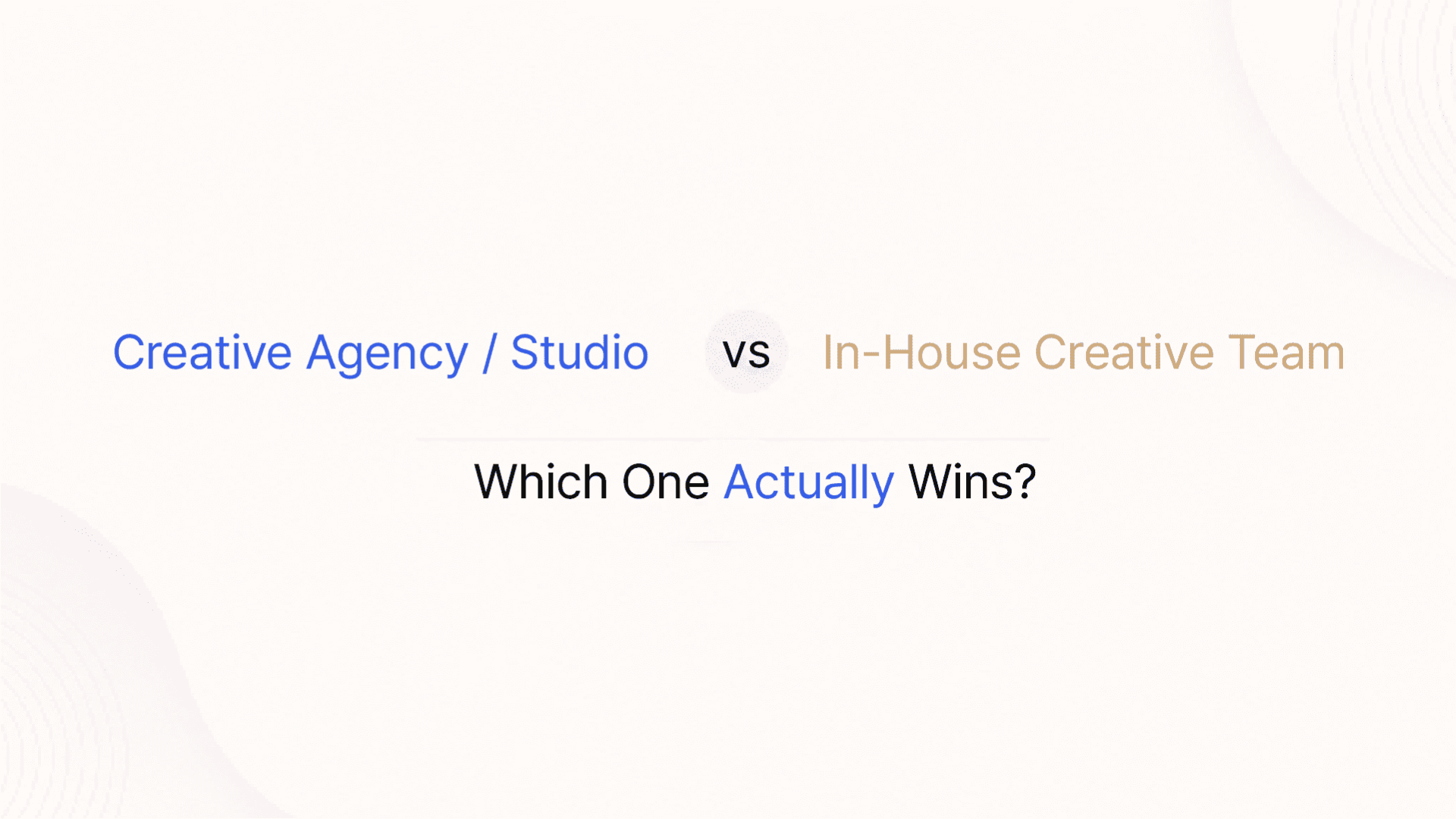
Companies scaling their marketing operations inevitably face a critical decision: should they build a creative department internally, or outsource the work to an external partner?
While an in-house creative team provides deep brand knowledge and immediate physical availability, a specialized creative agency offers a broader range of high-level skills, fresh industry perspectives, and scalable resources without the burden of overhead costs. For most mid-market and enterprise B2B brands, partnering with a multi-disciplinary agency yields a substantially higher return on investment (ROI) than trying to recruit, manage, and retain a comprehensive in-house team.
In this guide, we will break down the true costs, evaluate the pros and cons, and help you determine which structure aligns best with your business goals.
When comparing an agency versus an in-house creative team, leaders often make the mistake of comparing an agency's monthly retainer directly against a single designer's base salary. This is mathematically flawed.
The True Cost of an In-House Employee:
To accurately calculate the cost of an in-house creative professional, you must factor in the fully burdened cost. According to industry averages, an employee's true cost to the business is typically 1.25 to 1.4 times their base salary.
The Agency Financial Model:
Conversely, a creative agency operates on a clear, predictable pricing structure. Whether you engage them for a fixed-fee project or an ongoing monthly retainer, the price you see is the final cost. There are no surprise HR expenses, no software licenses to manage, and no paying for idle time. You are paying purely for targeted, high-impact creative output.
Building an internal marketing department has distinct advantages for companies with highly specific, continuous, low-complexity design needs.
The Pros of In-House:
The Cons of In-House:
For businesses that require high-caliber output, strategic guidance, and specialized capabilities, a design agency is often the superior choice.
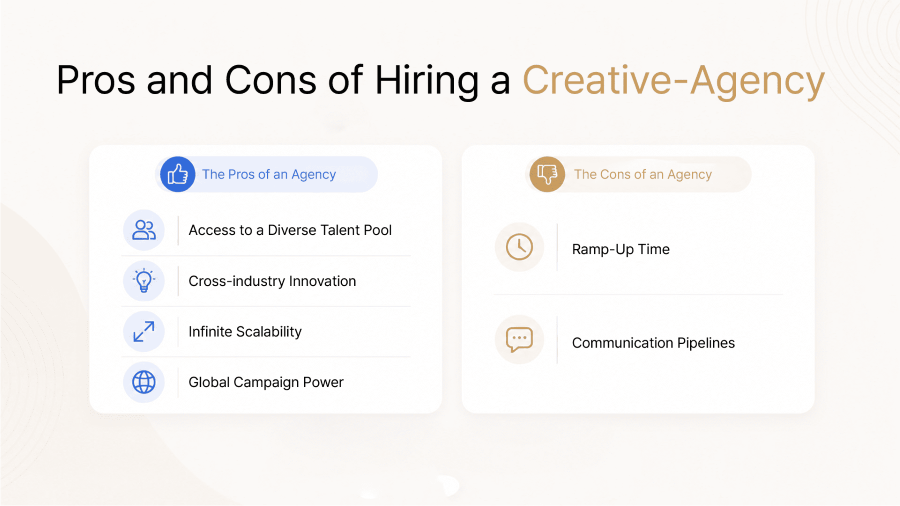
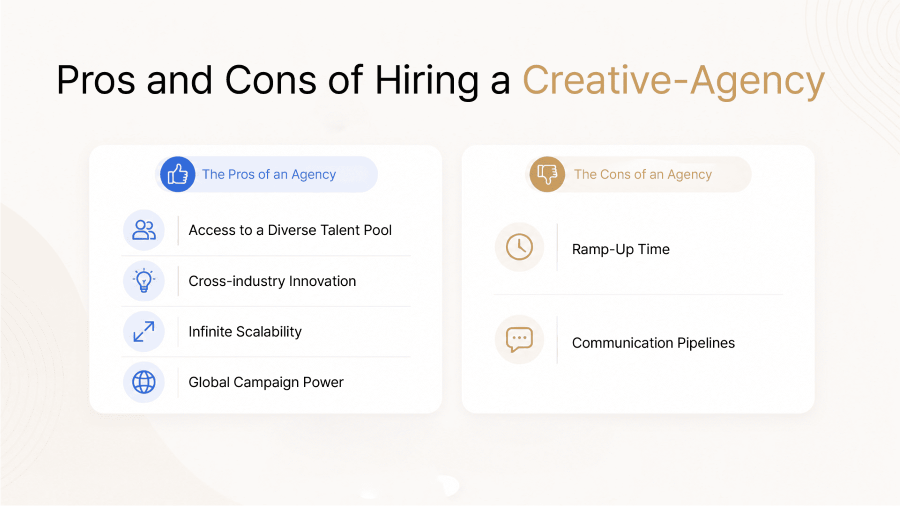
The Pros of an Agency:
The Cons of an Agency:
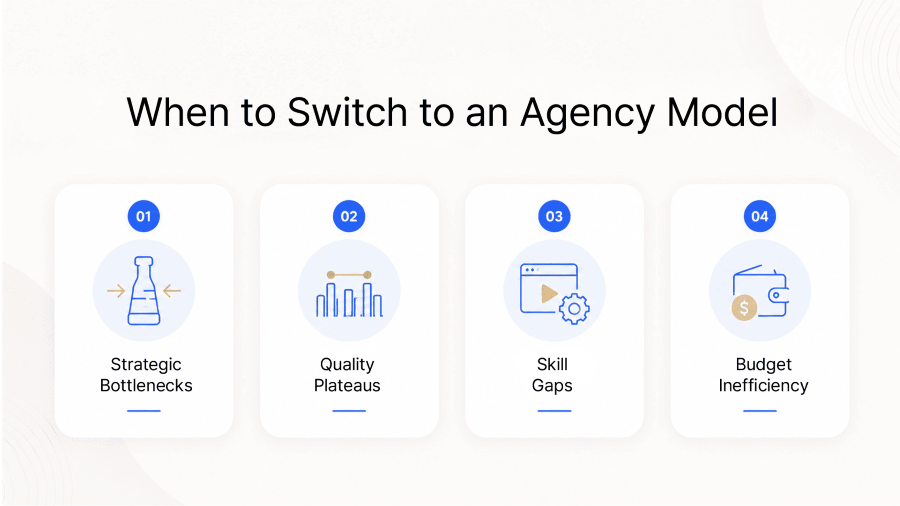
How do you know when it is time to transition from relying on an internal team to bringing on an agency partner? Look for these critical warning signs:
The reality is that "Agency vs In-House" is often a false dichotomy. The most successful modern brands utilize a hybrid structure.
In this model, the company retains a lean internal team, often a Marketing Director or an internal Brand Manager, who acts as the guardian of the brand. This individual manages internal stakeholders and handles fast-turnaround, low-impact tasks.
Simultaneously, the company partners with a premier design agency like Integra Magna to serve as their strategic and heavy-execution arm. The agency handles major website redesigns, complex brand identity overhauls, and high-fidelity campaign assets. This structure leverages the internal team's deep institutional knowledge while harnessing the agency's elite talent and scalability.
Choosing between an agency and an in-house creative team comes down to assessing your true operational costs, your need for diverse skill sets, and your desire for creative innovation. While an in-house team offers proximity, the compounding costs and limited capabilities often create long-term bottlenecks.
By partnering with a specialized creative agency, your brand gains access to elite, diverse talent, unmatched scalability, and the strategic foresight needed to dominate your market.
Ready to elevate your brand's creative output without the bloated overhead? Book a discovery call with Integra Magna today to see how our scalable design teams can transform your marketing engine.
Q: Is it cheaper to hire a creative agency or build an in-house team?
A: In the short term, an entry-level designer's salary may appear cheaper than an agency retainer. However, when factoring in fully burdened costs (benefits, taxes, software, recruitment) and the need for diverse skills (copywriting, development, animation), hiring an agency is highly cost-effective and provides a significantly higher ROI.
Q: How long does it take for a creative agency to understand my brand?
A: A top-tier agency typically requires a 2 to 4-week onboarding and discovery phase. During this time, they conduct stakeholder interviews, audit existing assets, and establish comprehensive brand guidelines to ensure immediate alignment on the first deliverable.
Q: What happens if an agency's style doesn't match our vision?
A: Professional agencies utilize structured review cycles and mood-boarding phases before executing final designs. This collaborative process ensures that the strategic vision is fully aligned before heavy production begins, dramatically reducing the risk of a stylistic mismatch.