

The best user experiences aren't accidents. Behind every effortless swipe, every confident purchase, and every brand you inexplicably trust on first visit there's a deliberate application of human psychology.
World-class brands like Decathlon, Swiggy, Apple, and Zara use behavioural and cognitive psychology principles to guide how users feel, decide, and act. Design psychology isn't a buzzword it's the competitive advantage hiding in plain sight.
Here's exactly how they do it.
Design psychology is the application of cognitive and behavioural science to the way products, interfaces, and brand experiences are structured.
It operates on a simple premise: humans are not rational actors. We make decisions based on emotion, habit, context, and cognitive shortcuts not deliberate analysis. Design psychology doesn't manipulate this. It works with it to create experiences that feel natural, trustworthy, and satisfying.
For brands, this matters because:
Design psychology isn't about tricking users. It's about removing the friction between what a user wants and what they do.
Decathlon's mission is "make sport accessible to all." This isn't just a tagline it's a design brief.
How it plays out:
The Integra Magna takeaway: Accessibility isn't charity design. It's the most commercially sound form of inclusion; it removes every possible reason not to convert.
Ordering food sounds simple. It isn't.
At peak usage, Swiggy users face an overwhelming number of restaurants, cuisines, and options all while hungry and impatient. This is a textbook environment for decision fatigue: the mental depletion that comes from making too many choices, leading to paralysis or regret.
How Swiggy fights decision fatigue:
Zara and the fast fashion industry have built multi-billion-dollar empires on a single psychological principle: scarcity drives urgency, and urgency drives action.
Zara's key psychology levers:
The ethical dimension: Scarcity design can shade into dark patterns when it's manufactured rather than real. Responsible brands and responsible designers apply urgency honestly.
Apple's design philosophy reduces everything to its most essential form. This isn't minimalism for aesthetics; it's cognitive load minimisation as a competitive strategy.
How Apple applies psychology:
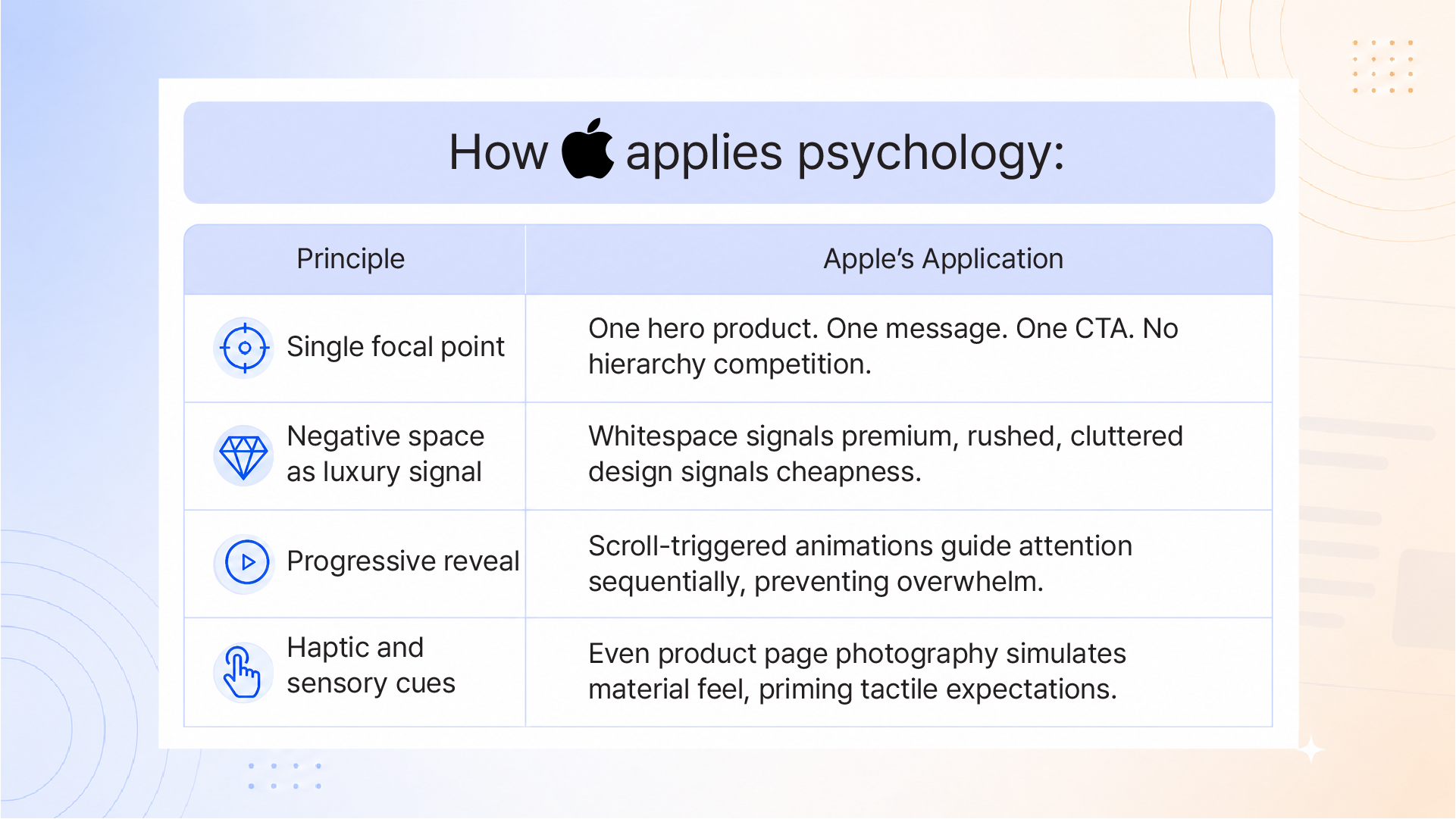
Apple demonstrates that simplicity is the most demanding design discipline. Removing something requires more strategic confidence than adding it.
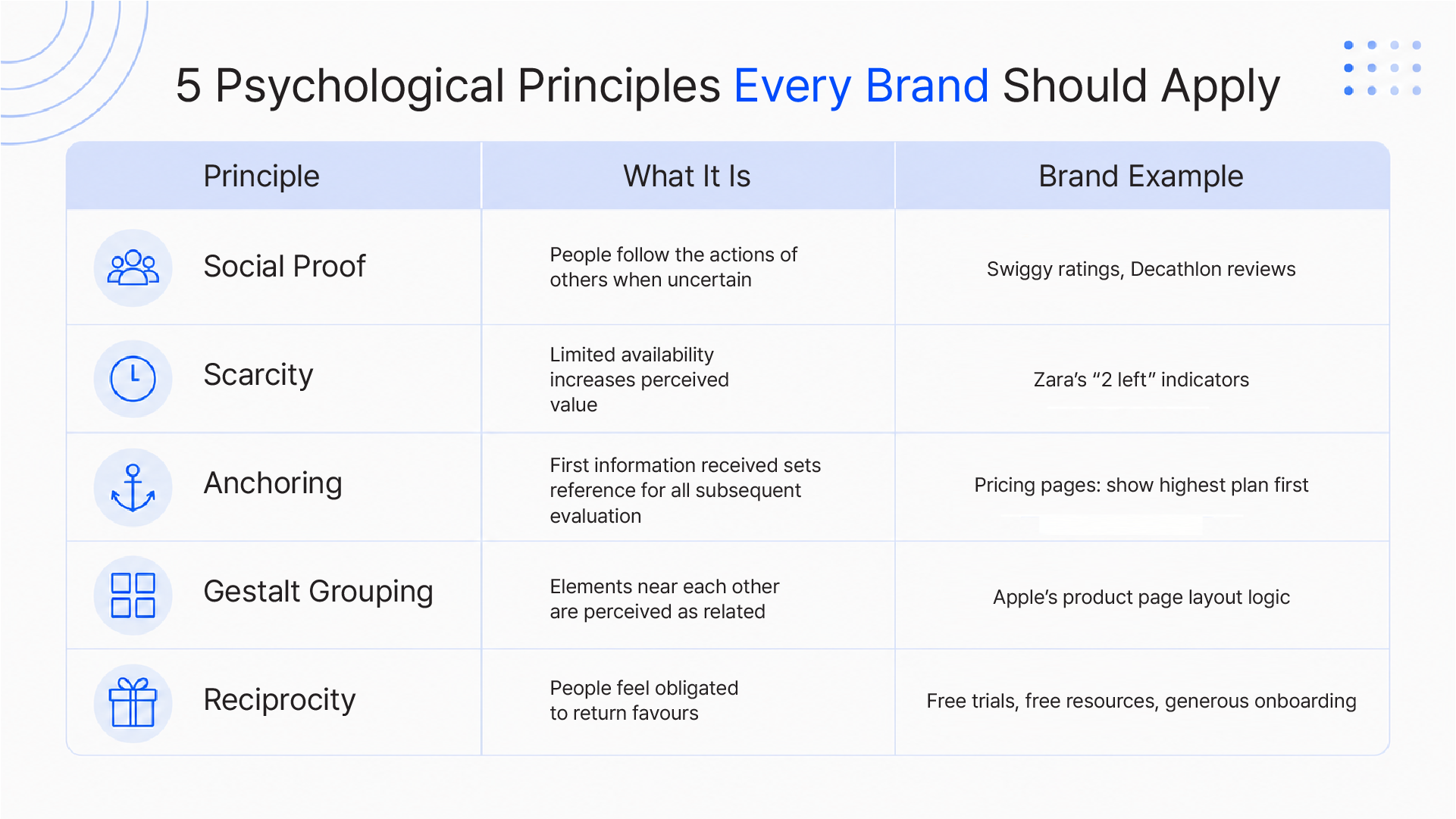
The brands that apply these principles strategically, not as tricks, but as genuine UX decisions that serve user goals, build the deepest trust and highest long-term loyalty.
There's an important distinction between persuasive design and deceptive design (dark patterns).
Design psychology done right:
Design psychology abused:
The best brands, Decathlon, Swiggy, and Apple, use psychology to serve the user. That's why they earn loyalty, not just transactions.
Want a brand experience that works as hard as your product does? Integra Magna builds design systems grounded in both aesthetics and behavioural science. From brand identity to UX strategy, we help companies build products people trust.
Q: How do brands use design psychology to influence customers?
Brands apply cognitive and behavioural psychology principles such as reducing decision fatigue, using social proof, and applying Hick's Law to create interfaces and experiences that make desired actions feel natural and effortless. The goal is to reduce friction between user intent and user action.
Q: What design psychology principles does Swiggy use?
Swiggy primarily applies Hick's Law (reducing choice to reduce decision time), progressive disclosure (showing complexity only when needed), social proof (ratings and reviews), and confidence design (real-time tracking, delivery time estimates) to create a high-speed, low-friction ordering experience.
Q: How does Decathlon use UX design to drive sales?
Decathlon structures its UX around accessibility and trust-building. It uses sport-identity navigation (categorised by activity rather than product type), educational content embedded in product pages to reduce beginner anxiety, and streamlined checkout to minimise drop-off. These decisions reflect its "sport for all" brand mission at every touchpoint.
Q: What is behavioural design in branding?
Behavioural design is the practice of using insights from cognitive and behavioural science to shape how users interact with products and brands. It includes applying principles like loss aversion, anchoring, scarcity, and social proof to design decisions not to manipulate, but to align product experiences with how human decision-making actually works.
Q: How does colour psychology affect brand perception?
Colour psychology studies the emotional and cognitive responses humans have to different colours. Blue signals trust and stability (widely used in fintech and healthcare). Green signals growth and safety. Red activates urgency and appetite. Strategic colour choices in brand design prime users for specific emotional states before any content is read.