


By 2035, analysts project that over 85 million jobs will be displaced by automation and 97 million new roles will emerge in industries that barely existed a decade ago. The economic playing field isn't just shifting. It's being rebuilt from the ground up.
The challenge isn't finding growth industries. The challenge is separating the ones with genuine structural tailwinds from the ones riding a hype cycle. This article focuses on the latter sectors with deep economic drivers, policy backing, and compounding demand curves.
Most "future trends" articles recycle the same five categories. What they miss is why these sectors are growing and what's sustaining them beyond novelty.
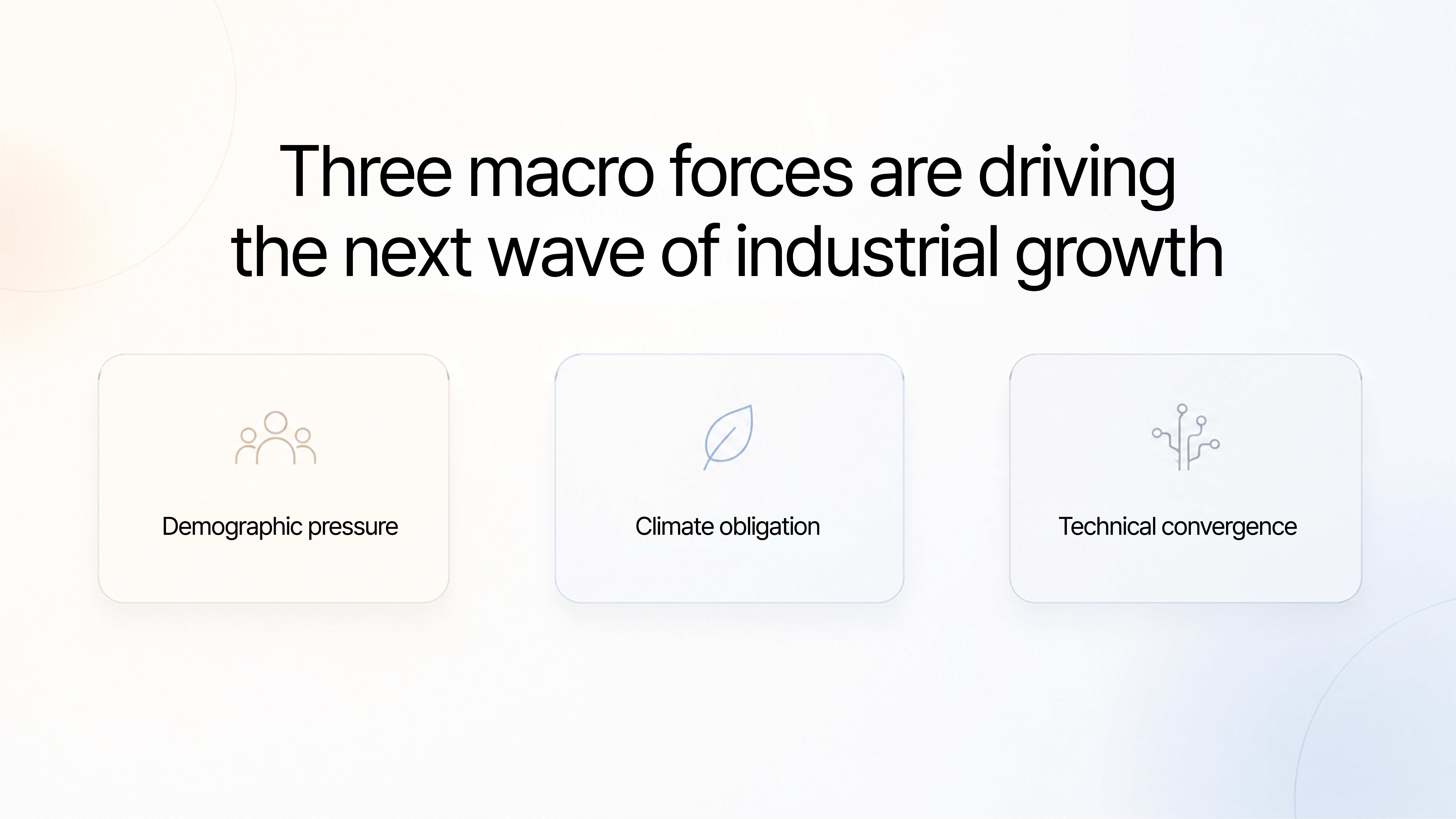
Three macro forces are driving the next wave of industrial growth:
These aren't trends. They're structural reconfigurations.
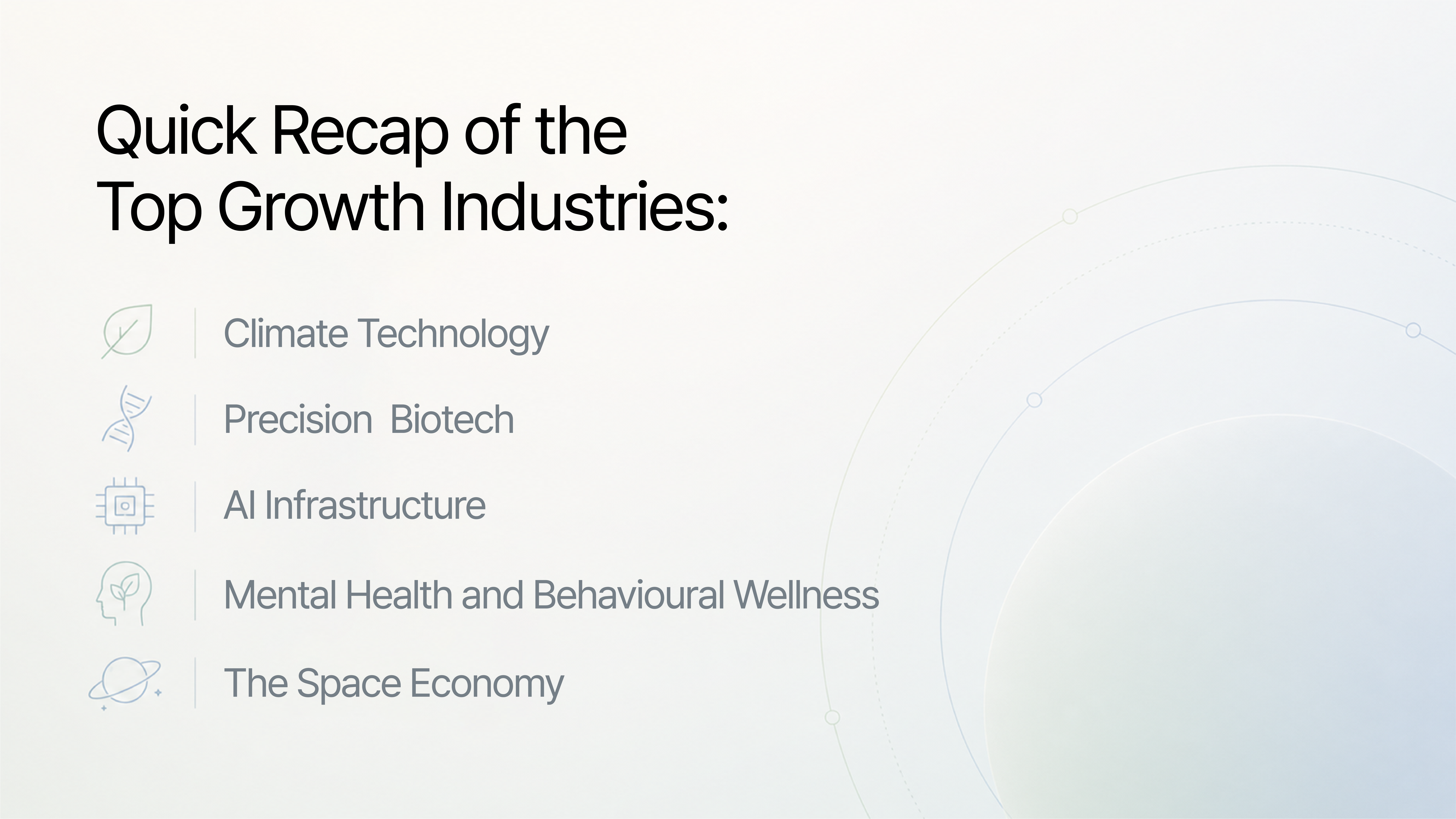
1. Climate Technology Beyond Solar Panels:
Climate tech is the largest capital allocation story of the next decade. It's not just solar and wind anymore.
What's growing fast right now:
The insight most miss: Climate tech winners won't be the companies building the greenest product. They'll be the ones solving the economics of the green transition making decarbonization cheaper, faster, and bankable.
2. Precision Biotech Personalised Medicine at Scale:
The global biotech market is projected to exceed $3.5 trillion by 2030, driven by breakthroughs that were science fiction a decade ago.
What's actually moving the needle:
The shift is from treating disease to predicting and preventing it. That's a trillion-dollar model change.
3. AI Infrastructure The Picks-and-Shovels Opportunity:
Everyone talks about AI. Few talk about the infrastructure making it possible.
The real growth isn't in the consumer-facing chatbots it's in:
The gold rush analogy is overused, but accurate here: you don't win by panning for gold, you win by selling pans.
4. Mental Health and Behavioural Wellness:
The global mental health market will reach $537 billion by 2030 driven by awareness, destigmatisation, and the collapse of traditional mental healthcare capacity in most countries.
What's emerging at scale:
This is not a "soft" sector. It is becoming a healthcare infrastructure story.
5. The Space Economy No Longer a Government Project:
The private space economy is projected to hit $1.8 trillion by 2035 (Morgan Stanley, 2024). The shift from government-led space programmes to commercial-led operations has unlocked entirely new revenue models:
The barrier used to be a rocket. Now it's a business model.
The companies and careers that will define 2035 are not waiting for a trend report. They are being built right now in labs, garages, and boardrooms by people who understood that real opportunity is found where structural need meets technological capability.
Growth industries don't announce themselves. They get diagnosed by those paying close attention.
If you're a founder building a business, a professional considering a pivot, or a brand looking to position itself in a high-growth sector the strategy starts with clear thinking, not reactive optimism.
Integra Magna is a humanly crafted brand strategy and design studio. We help founders and business leaders position their organisations for the markets of tomorrow not yesterday.
What are the fastest growing industries in the next 10 years?
The fastest growing industries from 2025 to 2035 include climate technology, precision biotech, AI infrastructure, behavioural mental health services, and the private space economy. These sectors are backed by structural macro forces demographic shifts, climate policy, and technological convergence not just venture capital enthusiasm.
Which industries will be most impacted by AI in the next decade?
Healthcare, legal services, financial analysis, logistics, and manufacturing will see the deepest AI disruption. However, the opportunity inside these sectors is in building AI-native tools and workflows not just adopting existing AI products.
What are the best growth industries to invest in for 2025–2035?
From an investment standpoint, climate tech infrastructure, AI picks-and-shovels (semiconductors, cooling, compliance), and precision medicine present the strongest structural tailwinds. These sectors benefit from policy support, capital flows, and long-term demand curves.
Is the mental health industry a good business opportunity?
Yes. The mental health industry is transitioning from a social cause to a healthcare infrastructure story. Digital therapeutics, workplace wellness B2B, and psychedelic-assisted therapy represent scalable, investable categories with regulatory frameworks forming rapidly.
How should founders position their business for emerging industries?
The strategic move is to identify adjacent enablers companies that make the leading sector function. In AI, it's infrastructure. In climate tech, it's carbon economics. In biotech, it's AI-accelerated discovery tools. Adjacency to a booming sector often carries higher margins and lower competition than being at the centre of it.