

Your rankings have not collapsed. Your website has not been penalised. Your content has not changed. But your organic traffic is down, and it has been falling consistently for months.
This is one of the most disorienting experiences a business can have in 2026, because the old diagnostics no longer explain the problem. The issue is not your site. The issue is that the way search engines deliver value to users has fundamentally changed, and the "rank and click" model that drove organic traffic for two decades is no longer the default.
Organic traffic is declining in 2026 primarily because of the widespread adoption of Google AI Overviews and the resulting rise of zero-click searches. Roughly 60% of Google searches now end without a single click to any website. The platform is answering queries directly, and your content may be contributing to those answers without generating a single visit.
For the past twenty years, SEO worked on a simple logic: rank high, get clicks, earn traffic.
That model is breaking.
Google's AI Overviews the synthesised, AI-generated answer blocks that now appear at the top of many search results have changed the relationship between ranking and traffic. Users see the answer directly in the SERP. They do not need to click. The query is resolved. The visit never happens.
This is not a penalty. It is not an algorithm update targeting your site. It is a structural transformation in how the platform delivers value, and it requires a structural response.
Key insight: The decline in organic traffic is not about your SEO going backwards. It is about the value exchange between search engines and websites, going through its most significant restructuring since Google became a monopoly.
Google AI Overviews (formerly Search Generative Experience) are now active across the majority of informational queries globally. When a user searches "how to improve website conversion rate" or "what causes brand inconsistency," they receive a synthesised, multi-source answer at the top of the page before a single organic result appears.
The impact on click-through rates is measurable and significant:
This is what analysts are calling "the Great Decoupling": the gap between your content's visibility (impressions) and the visits it actually generates (clicks).
What types of queries trigger this most?
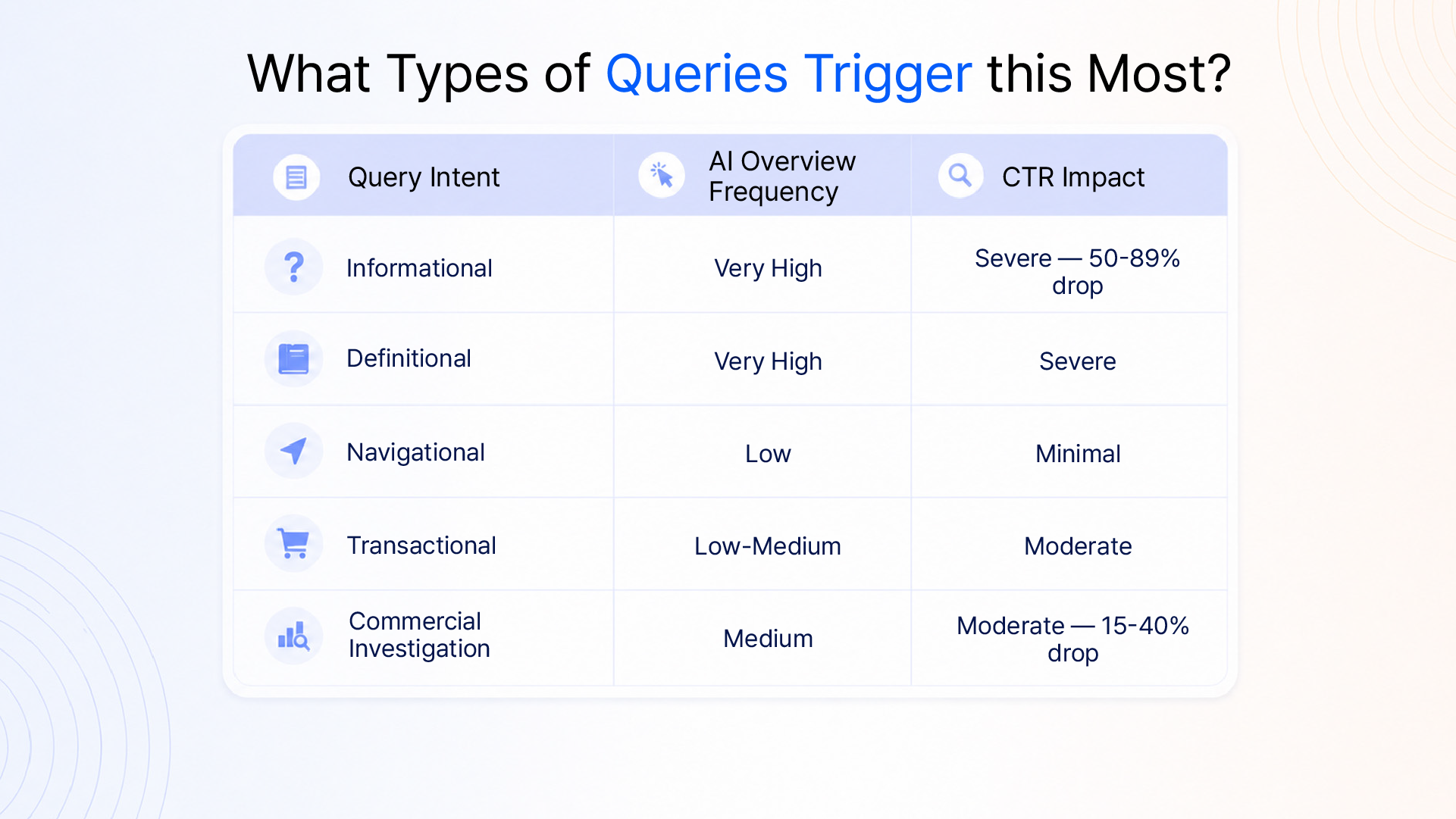
The closer your content sits to informational intent, the bread and butter of most content marketing strategies, the more exposed it is to this shift.
The decline in organic traffic is not limited to what Google's AI Overviews are doing. A parallel shift is happening at the user behaviour level: people are bypassing Google entirely.
AI-native search tools ChatGPT, Perplexity, Google Gemini, and Microsoft Copilot are now a primary research destination for a growing segment of users, particularly founders, marketers, and decision-makers. These are the exact audiences that B2B and premium B2C businesses are trying to reach.
When a founder asks ChatGPT, "What should I look for in a design and technology studio?" they are not opening a browser tab and running a Google search. They are receiving a synthesised recommendation, and only the brands that appear in those recommendations get visibility.
This matters for Integra Magna's ideal clients because:
The search landscape now has multiple parallel engines, each with different optimisation requirements.
Not all organic traffic is equally exposed to this shift. Understanding which content is most vulnerable and which remains relatively protected allows for a more strategic response.
Most affected:
Least affected:
The businesses most exposed are those whose content strategy relies heavily on informational volume publishing blog posts targeting high-volume awareness queries without deeper middle or bottom-of-funnel assets.
If clicks are no longer the primary output of SEO, what should you be measuring?
The answer is Share of Voice, specifically, how frequently your brand or content is cited, referenced, or summarised by AI systems when users ask questions relevant to your business.
Being cited in a Google AI Overview has a different value profile than a traditional organic click:
How to track Share of Voice in 2026:
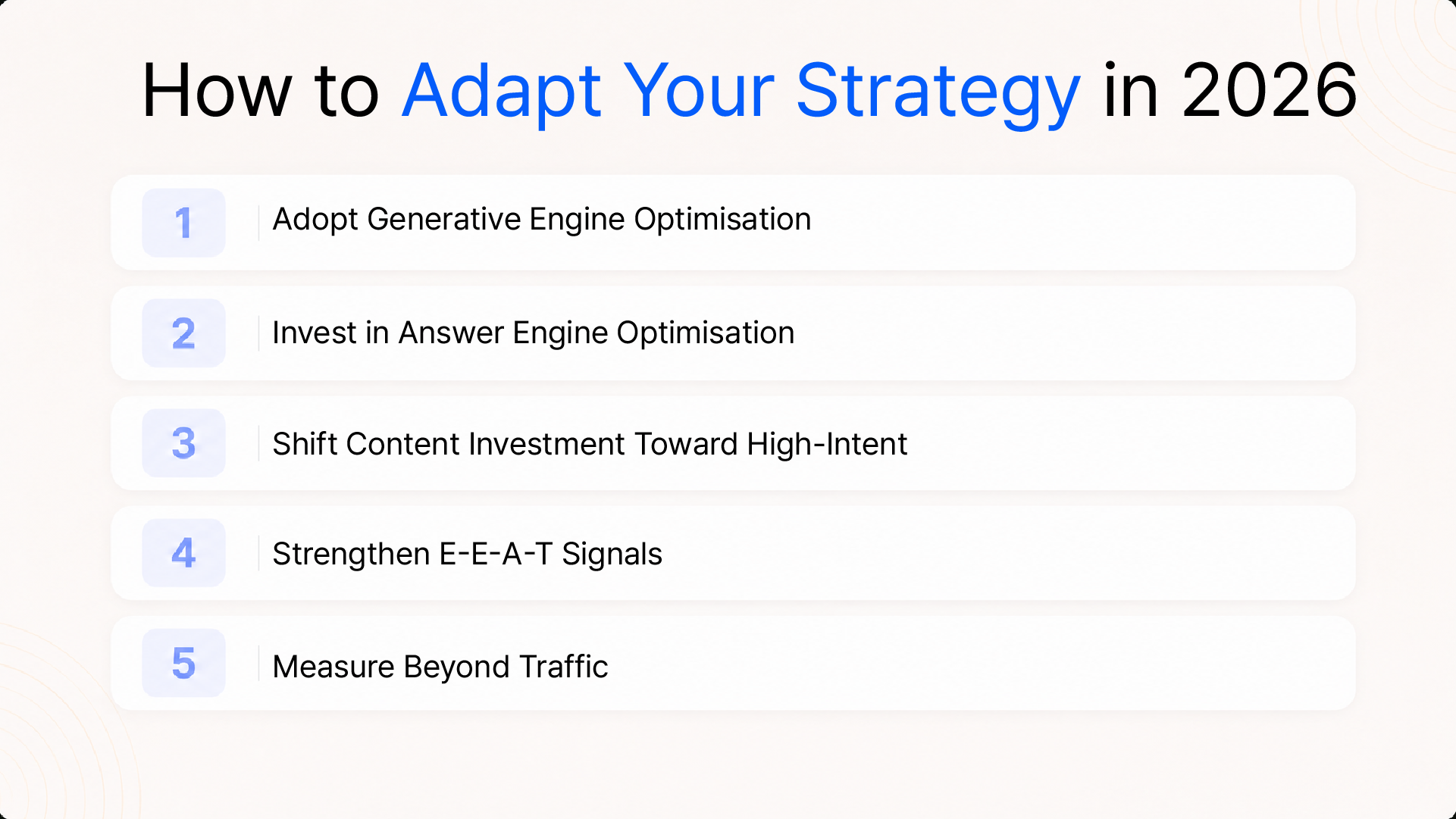
The strategic response to declining organic traffic is not to produce more content of the same type. It is to restructure what you produce, how you structure it, and what outcome you are optimising for.
GEO is the practice of structuring content so that AI systems can accurately extract, summarise, and cite it. Core principles:
AEO targets the "People Also Ask," and conversational query patterns that AI systems pull from. Add a structured FAQ section to every substantial piece of content, with direct, concise answers to the 3–5 most common follow-up questions.
Allocate more content resources toward middle and bottom-of-funnel assets:
Google's AI Overviews prioritise content from sources with demonstrated Experience, Expertise, Authoritativeness, and Trustworthiness. This means:
Stop using session volume as the primary content KPI. Add:
Organic traffic is declining in 2026, not because businesses have failed at SEO, but because the platform has transformed around them. The "rank and click" era is giving way to a "visibility and citation" era, and the businesses that adapt their content strategy to this new model will gain a compound advantage over competitors still optimising for the old one.
The question is not whether this shift is real. It is whether your content is structured to be cited, not just crawled.
At Integra Magna, we work at the intersection of content strategy, UX, and digital systems. If your organic traffic is declining and you want an honest diagnosis and a practical roadmap, not a generic list of fixes, let us talk.
Why is my organic traffic dropping even though my rankings haven't changed?
This is the defining symptom of the 2026 search shift. Google AI Overviews now provide direct answers at the top of many SERPs, particularly for informational queries. Your content may still rank and may even be used to generate an AI answer, but users do not click through because the query is resolved on the SERP itself. This is called the Great Decoupling: impressions remain stable while clicks decline.
How do AI Overviews affect SEO?
AI Overviews have reduced click-through rates by 15–89% for informational queries by answering questions directly in the SERP. The strategic implication is that SEO success can no longer be measured solely by traffic volume. Being cited as a source within an AI Overview, even without receiving a click, has real brand and authority value. Optimising for citation (GEO) is now as important as optimising for ranking (SEO).
What is a zero-click search?
A zero-click search is a search query that is resolved entirely within the search engine results page, without the user clicking through to any external website. In 2026, approximately 60% of Google searches end this way, driven primarily by AI Overviews, featured snippets, knowledge panels, and local packs. Zero-click searches are most common for informational, definitional, and simple navigational queries.
Should I still invest in SEO in 2026?
Yes, but the definition of SEO must expand. Traditional SEO (ranking for keywords to earn traffic) remains valuable for transactional and commercial queries where users still click through to act. However, it must now be paired with Generative Engine Optimisation (GEO) and Answer Engine Optimisation (AEO) strategies that improve your content's likelihood of being cited by AI systems. Abandoning SEO entirely would be a mistake; restructuring what it optimises for is essential.
How do I get my content cited in Google AI Overviews?
There is no direct submission mechanism. Citation in AI Overviews is earned through content quality, structure, and authority signals. Key factors: lead with direct answers, use structured formatting (lists, tables, clearly labelled sections), maintain high factual density with verifiable claims, build E-E-A-T signals (author credentials, case studies, external citations), and ensure your pages are technically accessible for AI crawlers. Content that answers a specific question clearly and directly is significantly more likely to be extracted and cited.