

If you've checked your analytics recently and noticed a steady, unexplained decline in organic traffic, you aren't alone. You haven't necessarily been penalized by a Google core update, and your content hasn't suddenly become irrelevant.
Your traffic is dropping because zero-click searches are rising as AI overviews (like Google's SGE) and answer engines (like ChatGPT and Perplexity) extract your answers and serve them directly to users. To fix an AI overview traffic drop, you must shift your content strategy to include Answer Engine Optimization (AEO) to provide concise, extractable answers and Generative Engine Optimization (GEO) to increase the factual density and semantic relationships within your content.
In this guide, we will break down exactly how the search landscape has fractured, and provide a concrete action plan to leverage AEO and GEO to win your visibility back.
For over a decade, the relationship between searchers and search engines was transactional. Users typed a query, search engines provided a list of blue links, and the user clicked through to your website. You won traffic, and users found information.
AI disrupted this transaction. According to recent search landscape studies, over 60% of all searches now end without a click.
Generative AI models and conversational search interfaces act as synthesized middlemen. When a user asks a question, the AI reads the top search results, compiles the best data, and generates a conversational summary right on the search engine results page (SERP). The user gets their answer without ever visiting your website.
This creates a terrifying reality for brands relying solely on traditional SEO. If you continue to write generic, long-winded content designed only to capture traditional keywords, you will continue to lose visibility to AI summaries. You need a new playbook.
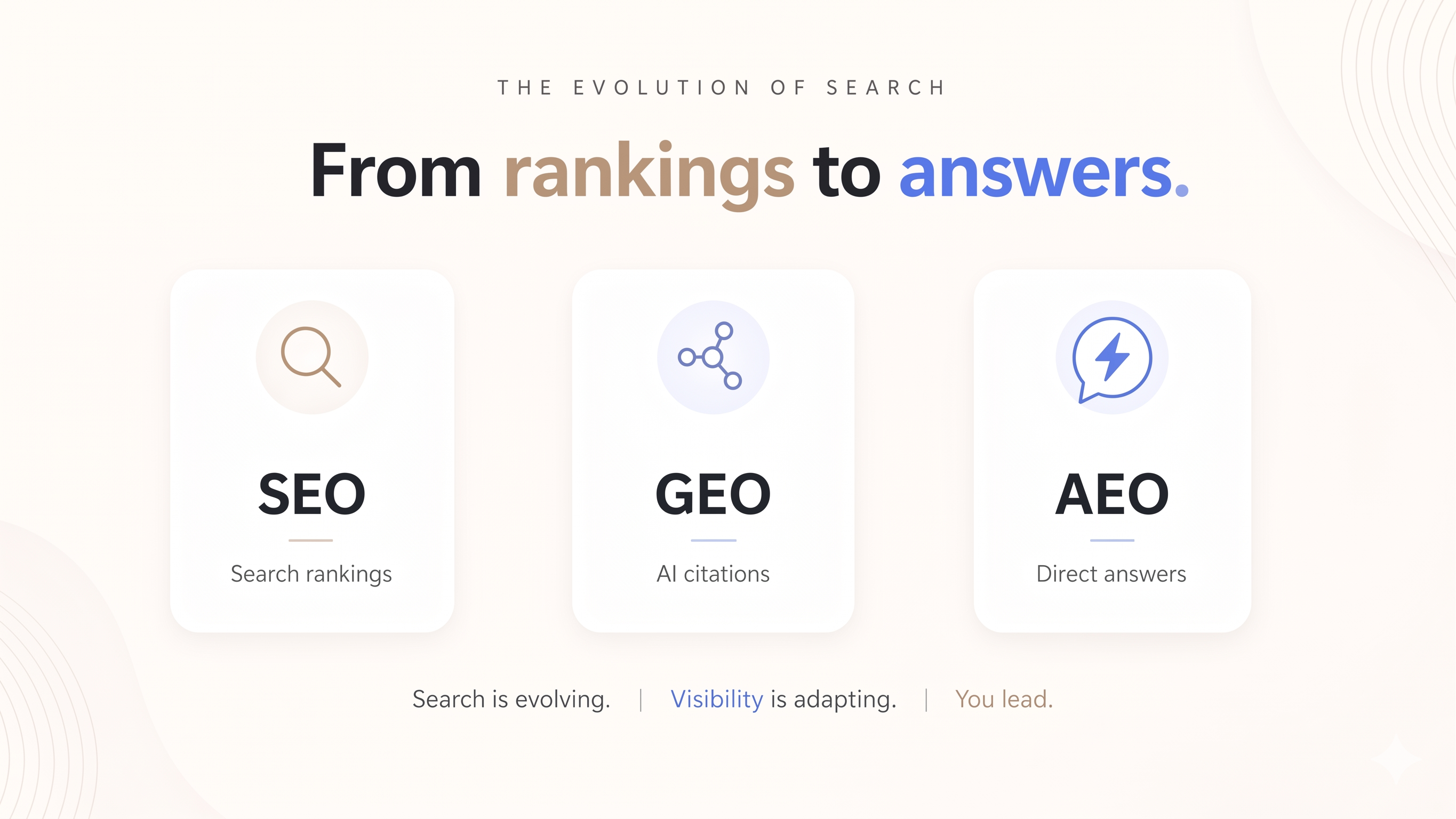
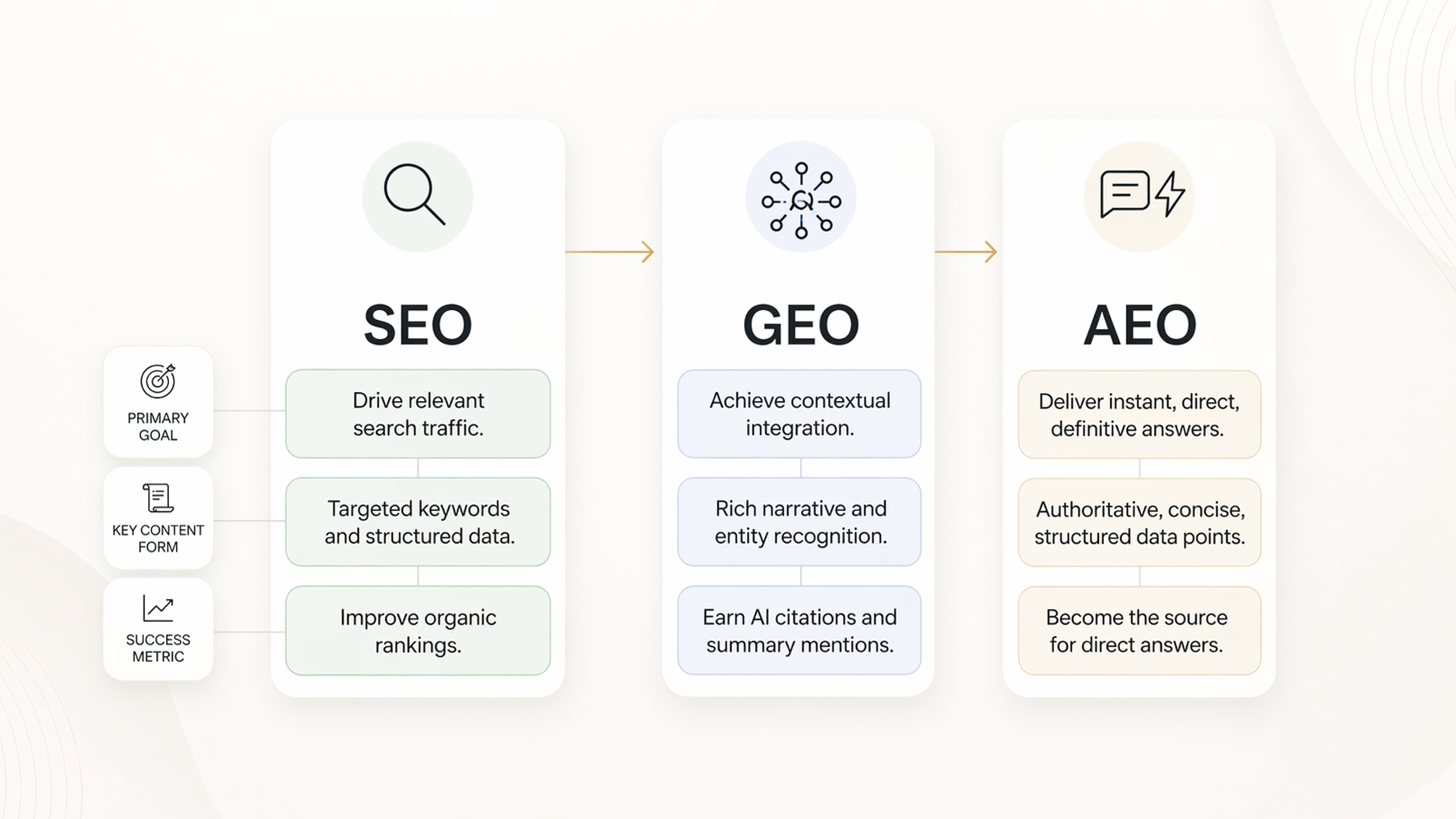
To stop the bleeding and recover your digital footprint, you must understand the new tripartite model of search visibility. Let's define the three distinct disciplines:
While SEO focuses on getting a user to click a link, GEO and AEO focus on ensuring your brand is the cited authority when the AI generates the answer.
AI models do not read content the way humans do. They do not care about your brand's clever metaphors or lengthy introductory paragraphs. They care about entities, relationships, and verifiable facts.
When a Generative Engine compiles an overview, it favors content with high factual density. This means the ratio of verifiable facts (data points, statistics, dates, clear definitions) to total word count must be exceptionally high.
How to optimize for GEO:
Key Insight: Generative engines look for consensus among top-ranking pages, but they reward unique value. If your page has the same information as the top 5 results, but adds a unique, verifiable statistic or an easy-to-read table, the AI is more likely to cite you as the primary source.
If GEO is about proving your factual authority to an AI, AEO is about giving the AI exactly what it needs to answer the user's question directly.
Answer engines like Perplexity or ChatGPT are conversational. Users don't type "best CRM software 2026." They ask, "What is the best CRM software for a 10-person creative agency using Macs?"
To win in AEO, you must anticipate these highly specific, conversational queries and provide immediate, objective answers.
How to optimize for AEO:
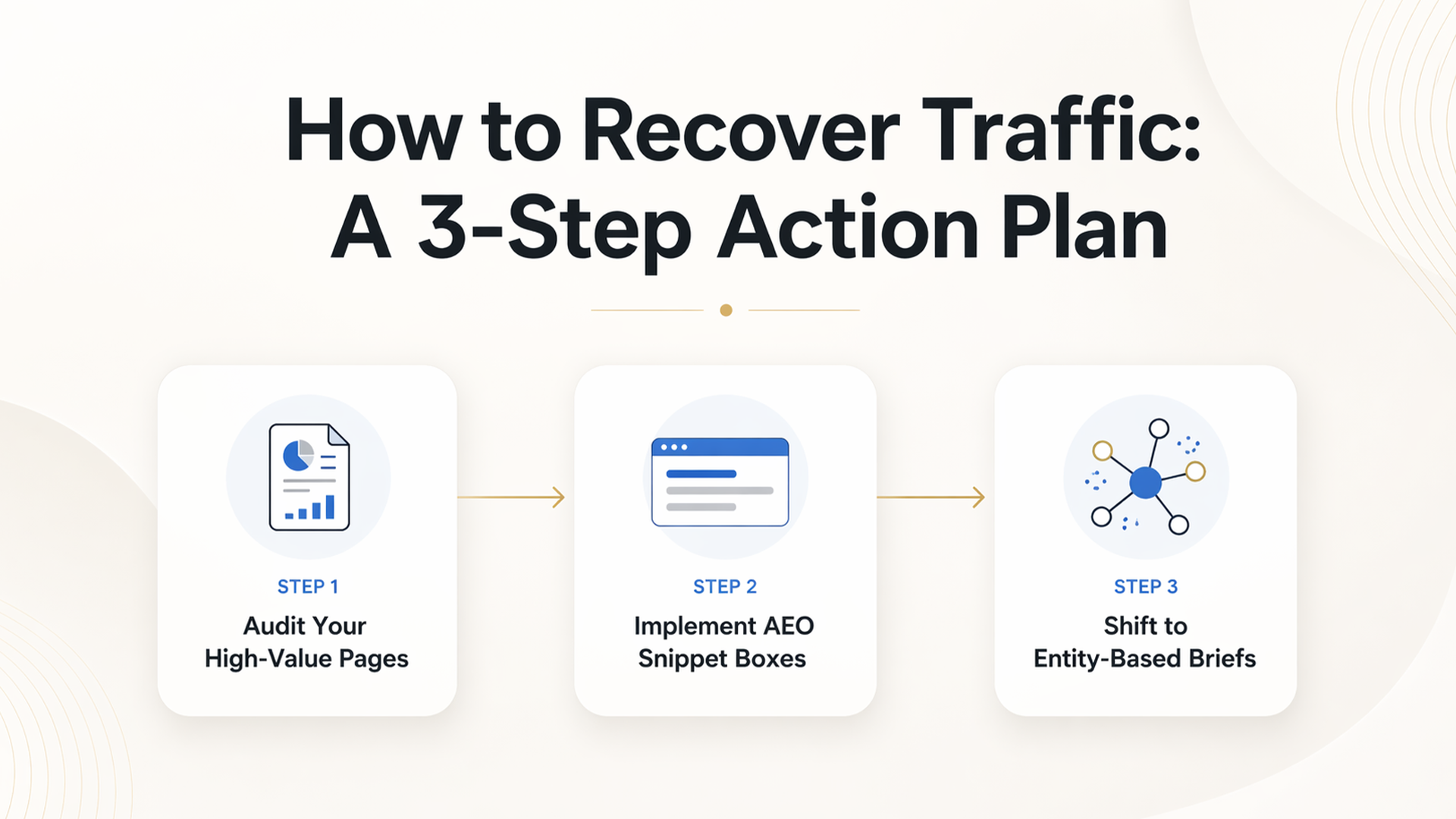
If you want to stop the AI overview traffic drop and reclaim your authority, implement this three-step framework into your content production process today:
Step 1: Audit Your High-Value Pages
Identify the pages that have lost the most traffic over the past 6 months. Search those exact queries in an AI Engine (like Perplexity) and a traditional engine (like Google). See what the AI is highlighting. If your content isn't being cited, analyze what the cited sources did differently. Usually, it comes down to clearer formatting or a more direct answer.
Step 2: Implement "AEO Snippet Boxes"
Go back into your top editorial content and add a direct, 50-word answer immediately after your H1 or primary H2s. Frame these as "Quick Answers" or "Key Takeaways." This immediately gives answer engines the perfectly sized chunk of data they need to cite your brand.
Step 3: Shift to Entity-Based Briefs
Stop building content briefs around a single target keyword. Instead, build your briefs around "Entities" (the people, places, concepts, and things related to the topic) and "Conversational Queries" (the exact questions people ask). Ensure your writers understand they are writing for a human reader, but structuring for an AI extractor.
The rise of AI search is not the death of organic visibility; it is simply a change in the rules of engagement. By understanding the distinct roles of SEO, GEO, and AEO, you can transition your brand from being a victim of zero-click searches to being the primary, authoritative source cited by the machines themselves.
Are you ready to future-proof your digital strategy? Focus on factual density, write clear answers, and optimize for the entire search ecosystem.
What is the difference between SEO and AEO?
SEO (Search Engine Optimization) focuses on optimizing web pages to rank higher on search engines to drive clicks and website traffic. AEO (Answer Engine Optimization) focuses on structuring content so it can be easily extracted and cited by conversational AI tools and voice assistants, often satisfying the user's intent without a click.
Which is more important, GEO or SEO?
Neither is strictly more important; they serve different purposes. SEO remains critical for transactional queries where users want to browse options or make a purchase. GEO is increasingly vital for informational queries, ensuring your brand is cited as the authority when an AI generates a summary of a complex topic. You need both for a holistic strategy.
How do you measure AEO success if traffic is dropping?
Because AEO often results in zero-click searches, traditional traffic metrics are insufficient. Success in AEO should be measured by "Brand Mentions as Citations" within AI platforms, share of voice in AI-generated answers, and an increase in direct brand searches (users querying your brand name specifically after seeing you cited by an AI).