
.png)
Not the right ones. AI is automating the repetitive, the predictable, and the templated layers of design work. But it cannot replicate strategic thinking, cultural empathy, or the ability to make meaning out of ambiguity. The designers at risk are not those who use AI; they are those who refuse to.
Design is not disappearing. It is upgrading. And the upgrade is non-negotiable.
In specific corners of the industry, yes, displacement is already happening.
Consider the numbers:
The entry-level, execution-heavy, and template-dependent design roles are the most exposed. The creative leadership, strategy, and experience design roles are not.
Key Takeaway: AI is not replacing designers; it is replacing the lowest-skill version of design work. The designers delivering thinking, not just output, are more valuable than ever.
No, and the reason is not sentimental. It is structural.
AI generates outputs by recombining patterns it has learned from existing data. It has no understanding of cultural nuance, brand intent, user psychology, or business context. It produces visually competent results, but visually competent is not the same as strategically correct.
The gap that matters: AI can produce a hundred logo variations in seconds. It cannot tell you which one will resonate with a cautious enterprise buyer in a regulated industry. That judgment requires a designer who understands people, markets, and strategy simultaneously.
AI is a tool that amplifies design output. It is not a replacement for design thinking.
Not all design roles carry equal risk. Here is an honest, ranked assessment:
High Risk (Execution-Heavy Roles):
Medium Risk (Hybrid Roles):
Low Risk (Strategy and Systems Roles):
Brand strategists and creative directors AI cannot own the brand vision
UX researchers’ human empathy and qualitative insight cannot be automated
Design system architects' AI tools require human governance to function coherently
Service and experience designers, the discipline is inherently human-centered
Five capabilities that AI cannot replicate and that define the next generation of design value:
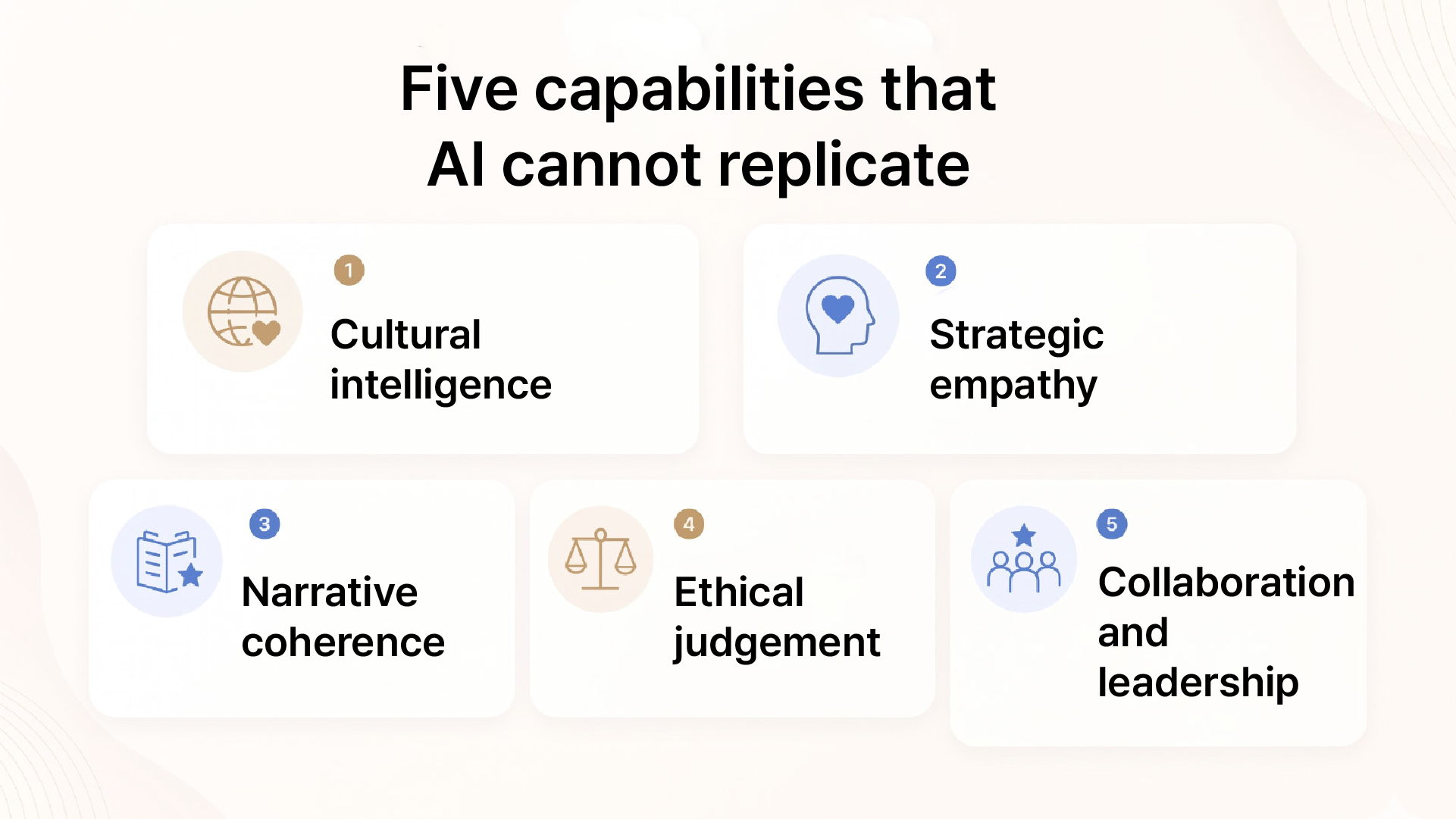
The shift is not from human to machine; it is from solo practitioner to human-AI creative system.
The most competitive designers of 2026 are not faster artists. They are operators who use AI to:
Prototype and test ideas earlier in the process, reducing the cost of creative risk
The industry is not getting smaller. It is getting more demanding. Clients now expect faster turnarounds, more iterations, and strategic quality simultaneously. Designers who use AI to deliver all three will lead. Those who don't will fall behind on capacity and competitiveness.
Key Takeaway: AI is not a threat to designers. The threat is choosing not to integrate it and losing ground to those who have.
The future belongs to designers who invest in the right capabilities now:
The designers who invest in this stack will not just survive. They will be the most sought-after creative professionals in the market.
The design profession will not shrink. It will stratify.
By 2035, the design industry will function across three distinct tiers:
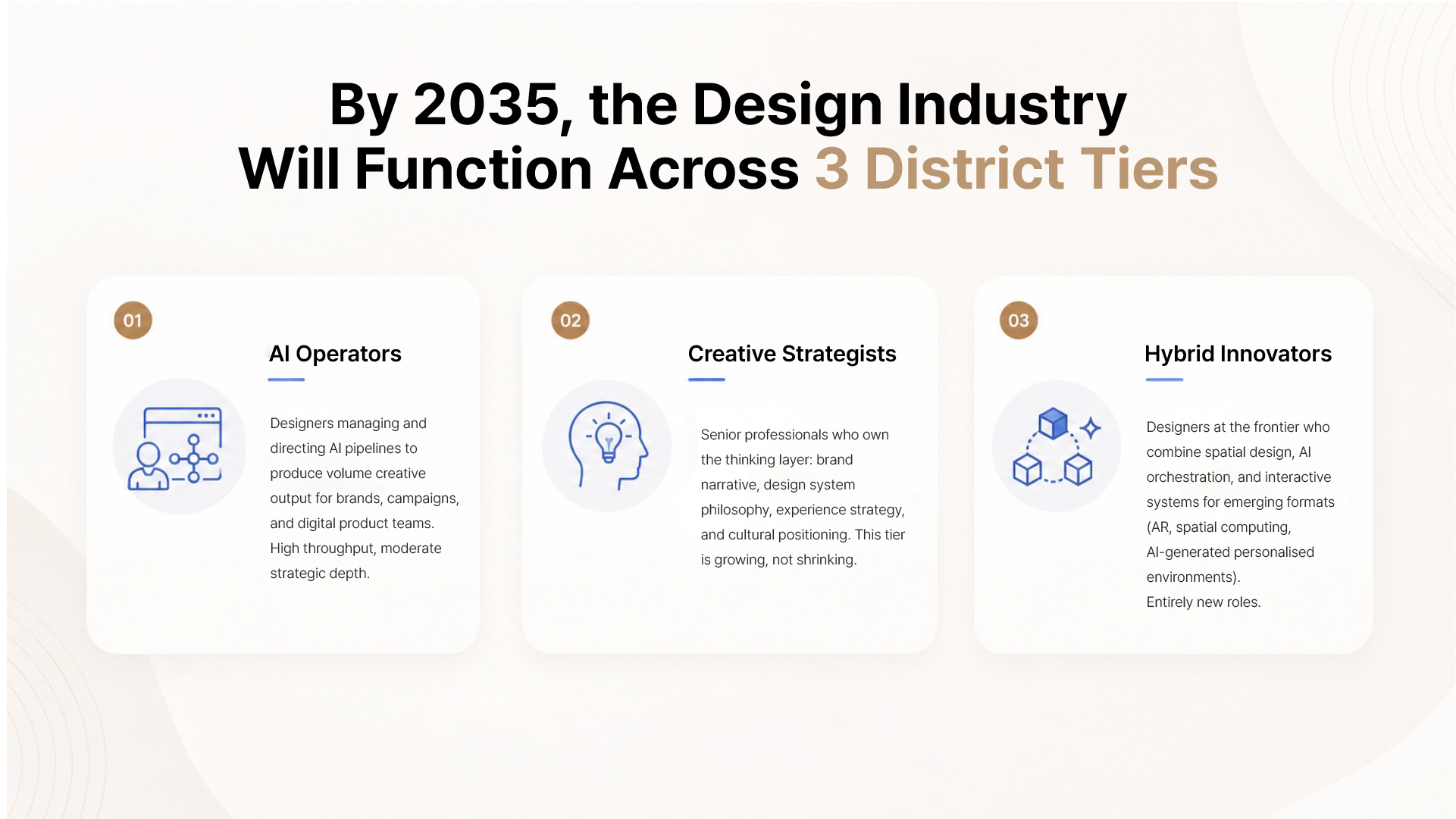
The question is not whether design has a future. It clearly does. The question is which tier of that future you are positioning yourself for and whether your current skill stack gets you there.
At Integra Magna, we believe this clearly: design without strategic depth is a commodity. Strategic design, the kind that connects brand, behavior, and business, is more valuable in an AI world, not less. Because AI produces the canvas. The designer still decides what it means.
AI is not coming for design. It is coming for the version of design that never had much value to begin with: the rote, the repetitive, the purely executional.
The design profession that remains and grows is the one built on strategic clarity, cultural intelligence, and the fundamentally human act of making things that matter to people.
The designers who ask "Will AI take my job?" are asking the wrong question. The right question is: "What kind of designer am I becoming, and is that designer irreplaceable?"
At Integra Magna, we have always believed that design is not decoration. It is decision-making made visible. And no AI, however capable, can replace the human who decides what to stand for.
The future belongs to designers who evolve. Start now.
Will designers lose their jobs to AI?
Some design roles are already being displaced, particularly execution-heavy, template-based, and high-volume production work. However, designers in strategic, research-led, and experience design roles are not at risk. The profession is not disappearing; it is being restructured around higher-order skills.
Can AI fully replace human designers?
No. AI can generate, iterate, and optimize visual output at scale. What it cannot do is understand cultural context, make ethical judgments, build strategic brand narratives, or lead the kind of human collaboration that design leadership requires. These remain irrevocably human capabilities.
What makes designers irreplaceable?
Designers are irreplaceable when they operate at the intersection of strategic empathy, cultural intelligence, and systems thinking. These capabilities, the ability to understand people, build meaning, and guide organizations through ambiguous creative decisions, cannot be automated.
What types of design jobs are most at risk?
Template-based graphic design, stock illustration, basic UI wireframing, and print production design face the highest displacement risk. UX research, brand strategy, creative direction, and service design face the lowest risk because they are grounded in human judgment.
What skills do designers need to survive AI?
Prompt engineering, systems thinking, brand strategy literacy, user research skills, AI tool fluency (Midjourney, Figma AI, Adobe Firefly), and creative direction. Designers who invest in these capabilities will lead the industry.
What is the future of design as a career?
Design as a career has a strong future, but it is stratifying into tears. AI operators, creative strategists, and hybrid innovators will define the next era. Designers who commit to strategic depth will see their value increase, not decrease, in an AI-saturated market.