

Yes, but only as a luxury. In the emerging data economy, privacy is transitioning from a universal right into a premium product. Those who can pay for encrypted services, data sovereignty tools, and privacy-first technology will retain it. Those who cannot will trade it silently for free apps, personalised offers, and connected convenience.
Privacy is not dying. It is being commodified.
That distinction matters because if you understand it, you can fight back. If you don't, you'll lose something you never thought to protect until it was already gone.
In practical terms, yes, for most people, digital privacy is already severely eroded.
Consider:
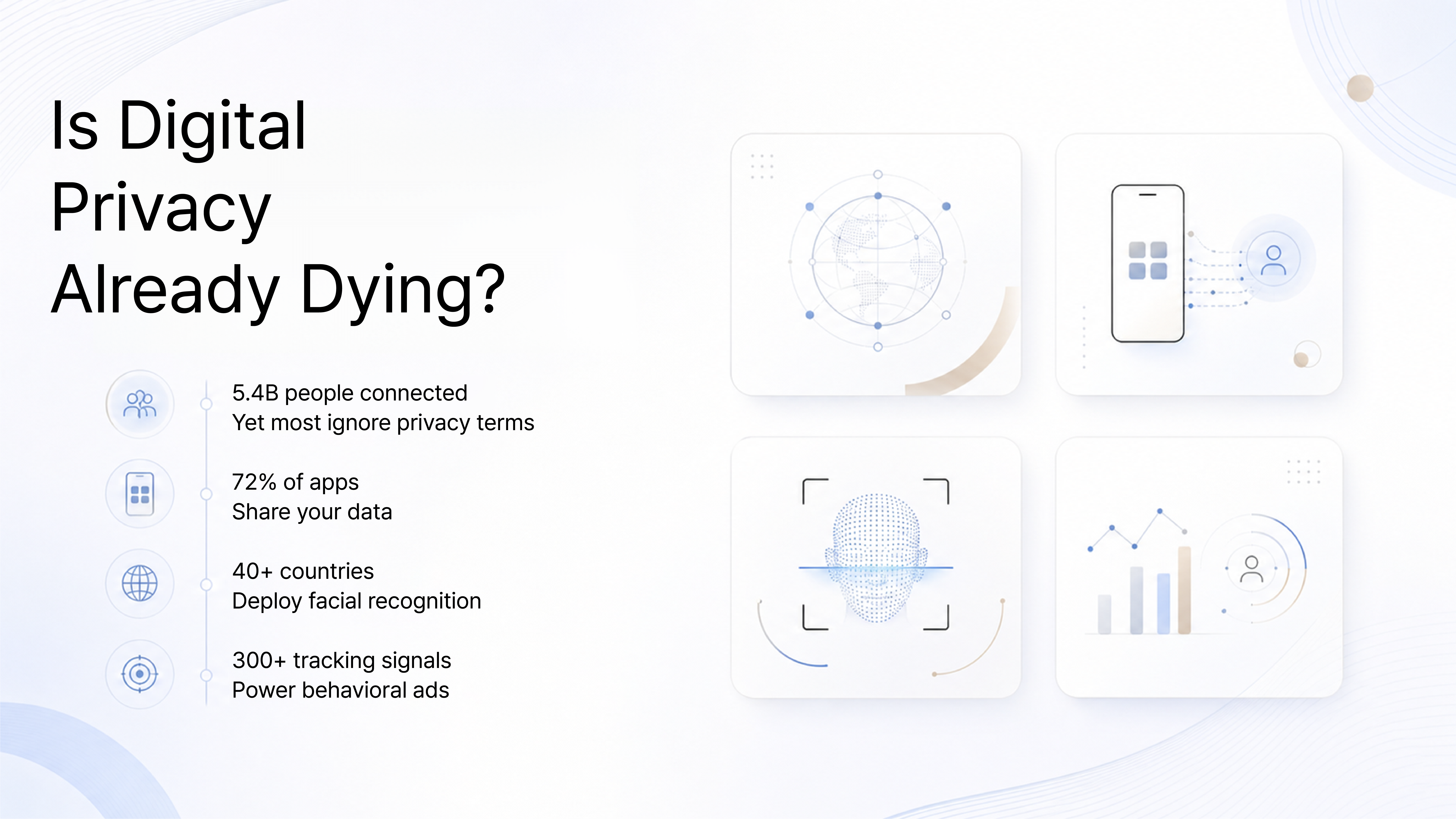
This isn't speculation. This is the architecture of the internet you use every day.
Key Takeaway: Digital privacy hasn't ended; it has quietly moved behind a paywall. If you're not paying for the product, you almost certainly are the product.
Artificial intelligence doesn't just use your data, it weaponises it at a scale no human operation could.
Here is how AI specifically amplifies the privacy threat:
The threat is no longer just data collection. It is data prediction.
Surveillance capitalism is the economic system in which human behaviour is the raw material for commercial profit. First named by scholar Shoshana Zuboff, it describes how tech platforms harvest behavioural data at scale, convert it into predictive products, and sell those predictions to advertisers, governments, and insurers without the individual's meaningful consent.
Why does it matter? Because it is not a bug. It is the business model.
Google, Meta, TikTok, and thousands of smaller platforms are structurally designed to maximise data extraction. Privacy regulations like GDPR have created compliance theatre, not genuine protection.
Yes, but only by design, not by default.
The history of the internet has proven that privacy does not emerge naturally from technological progress. It must be architected in. There are encouraging proof points:
These examples prove something critical: when privacy is made easy, people choose it.
Key Takeaway: Privacy and technology can coexist, but only when privacy is the default, not the exception. Right now, the opposite is true for most platforms.
Privacy by Design (PbD) is a framework developed by Ann Cavoukian that embeds data protection into the architecture of a system from the beginning rather than bolting it on as a compliance afterthought.
Its seven principles include:
Does it work? In organisations where it is implemented with genuine commitment, yes. In organisations where it is treated as a checklist. The principle is sound. The execution gap is the problem.
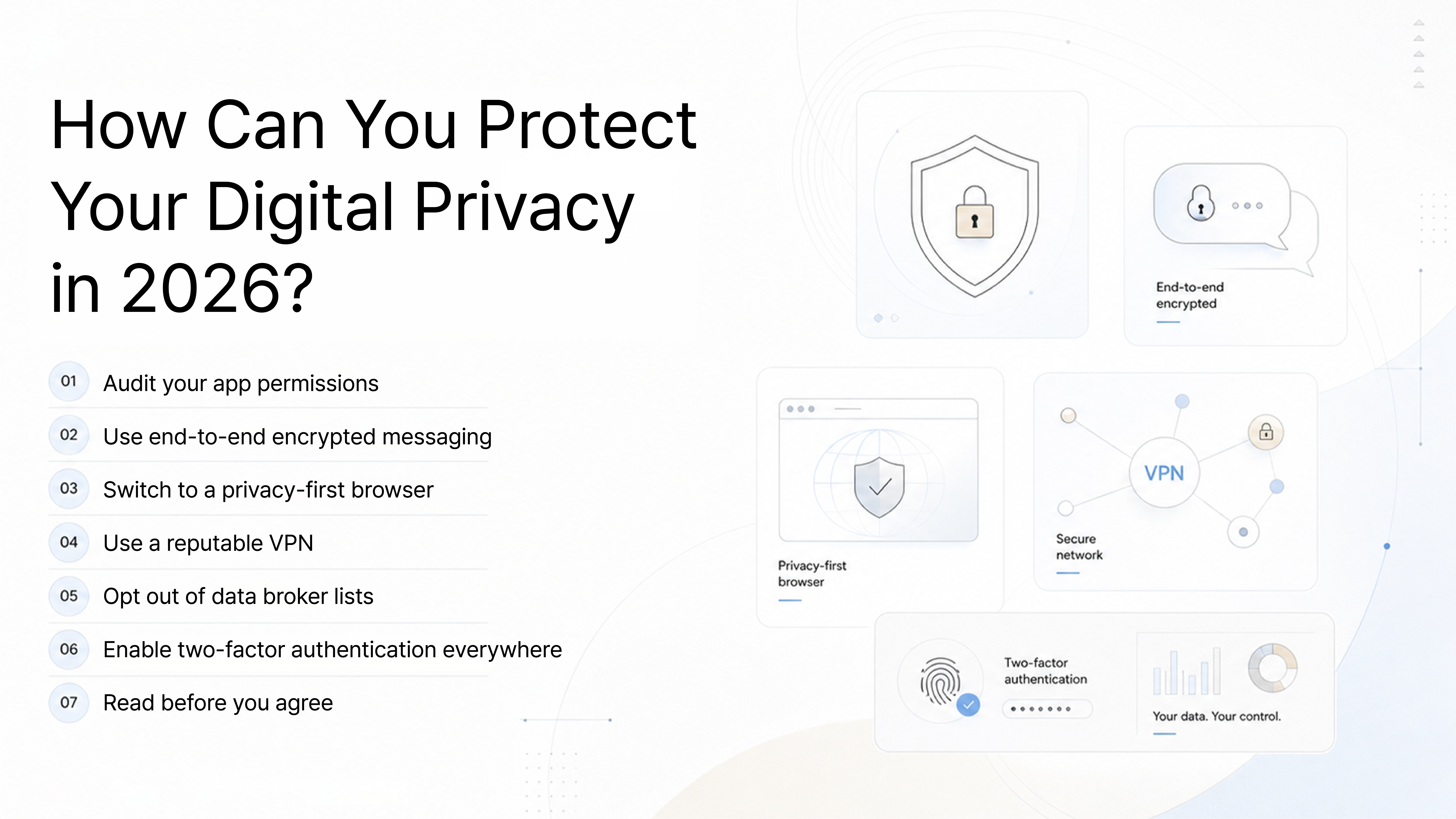
You have more agency than the system wants you to believe. Here is where to start:
By 2035, privacy will exist on a spectrum shaped by four emerging forces:
The future of privacy is not binary: private or surveilled. It is a negotiated, layered, contested space. And the outcome depends heavily on the choices made by designers, technologists, and policymakers in the next five years.
At Integra Magna, our view is direct: design that does not consider the user's data rights is not human-centred. It is an extraction wearing the mask of experience.
The future of privacy will not be decided by governments or corporations alone. It will be decided by the daily choices of individuals, designers, engineers, and leaders who either accept the default surveillance or actively build, demand, and fund alternatives.
Privacy is not disappearing. It is becoming a design choice.
And design choices, as we know at Integra Magna, are never neutral.
Choose what you build. Choose what you use. Choose what you protect.
Will privacy exist in the future?
Privacy will exist in the future, but not as a universal right enjoyed equally. It is rapidly becoming a tiered commodity accessible to those who understand, invest in, and actively defend it. For everyone else, the default is data exposure.
Is digital privacy dying?
Not dying eroding. Billions of people remain online under terms of service that authorise sweeping data collection. Meaningful consent is rarely informed. The architecture of the modern internet is structurally hostile to natural privacy.
How does AI threaten privacy?
AI threatens privacy through pattern inference, emotion analysis, synthetic identity generation, ambient surveillance via smart devices, and predictive data harvesting. It amplifies data collection to a scale and depth no prior technology could achieve.
What is surveillance capitalism?
Surveillance capitalism is an economic system, first defined by Shoshana Zuboff, in which human behavioural data is the primary raw material for commercial profit. Platforms harvest behaviour, convert it into predictions, and sell those predictions without meaningful user consent.
Can privacy and technology coexist?
Yes, but only when privacy is built into technology by design, not added as a compliance feature. Signal, Brave, and Apple's tracking transparency framework demonstrate that when privacy is made accessible, users choose it decisively.
What is privacy by design?
Privacy by Design is a framework that embeds data protection into a system's architecture from inception. Its core principle: privacy is the default, not an opt-in. It was developed by Ann Cavoukian and is now a cornerstone of GDPR compliance in the EU.
How can I protect my digital privacy in 2026?
Audit app permissions regularly. Use Signal for messaging and Brave for browsing. Enable two-factor authentication. Opt out of data broker lists. Use a verified no-log VPN. These steps materially reduce your exposure without requiring technical expertise.